

When Prices Move Before the Story Does
The first quarter of 2026 didn't introduce a new problem. It forced markets to confront several existing ones at once: geopolitics, energy, inflation, and a Federal Reserve with little urgency to move. Markets repriced accordingly.
That's the most useful way to read the last three months. Not "what went wrong," but what changed in the price investors were willing to pay for risk. The underlying economy didn't suddenly break. What shifted was how much uncertainty investors were willing to absorb, and what they were willing to pay for future earnings while doing it.
Markets answered that question quickly. The S&P 500 finished Q1 down roughly 4.6%, the Nasdaq down 7.1%, and the Dow down 3.6%. Bonds offered less shelter than usual, as yields climbed before stabilizing late in the quarter. That combination of lower equities and compressed diversification is what makes periods like this feel particularly frustrating. Everything moved in the wrong direction at once.
The quarter ended on a sharp note. The Dow gained more than 1,100 points on the final trading day of March, which is its own kind of signal. Markets don't drift sideways when they're repricing. They overshoot, stabilize, and then correct. That final rally didn't erase the quarter, but it reinforced the point: this was about expectations, not a verdict on the economy.
What Drove the Move
Three things collided in Q1 in a way that gave investors very little room to feel comfortable.
The first was geopolitics. The conflict in the Middle East moved from background risk to an active market variable. Oil moved with it, with Brent crude briefly approaching levels not seen in years. That matters because energy feeds directly into inflation expectations, which feeds into Fed policy, which feeds into everything else. One input changed several others at once.
The second was the Fed. In March, the FOMC held rates steady within the 3.50%-3.75% target range. That was expected. What was less comfortable was the tone: elevated uncertainty, higher inflation projections, and no urgency to ease. The Fed's updated projections moved its 2026 PCE inflation forecast from 2.4% to 2.7%, a meaningful shift for a central bank trying to signal stability.
Markets tend to move most when the range of possible outcomes widens, not necessarily when the most negative outcome becomes the most likely.
The third was the data itself, which pointed to deceleration, not collapse. February CPI came in at 2.4% year over year, with core CPI at 2.5%. The Fed's preferred gauge (core PCE) was 3.1% year over year in the latest available January release. These are materially better numbers than 2022. But they are still above the 2% target. Inflation is improved. It is not finished.
The Data: Inflation Still Above Target, But Not Accelerating
The labor market reinforced this picture through quarter-end. February payrolls declined by 92,000, while the unemployment rate held at 4.4%. Job openings and hiring both slowed. This is not a recession signal, but it does suggest an economy that has lost some altitude and is more sensitive to additional shocks than it was a year ago.
The March jobs report, released April 3, showed +178,000 payrolls and 4.3% unemployment, with February revised lower. A more mixed picture, and one markets are still digesting.
Here's What Most People Are Missing
The most important data point of the quarter wasn't the index returns. It was the divergence between those returns and earnings expectations.
The easiest way to see this is in the relationship between price and earnings:
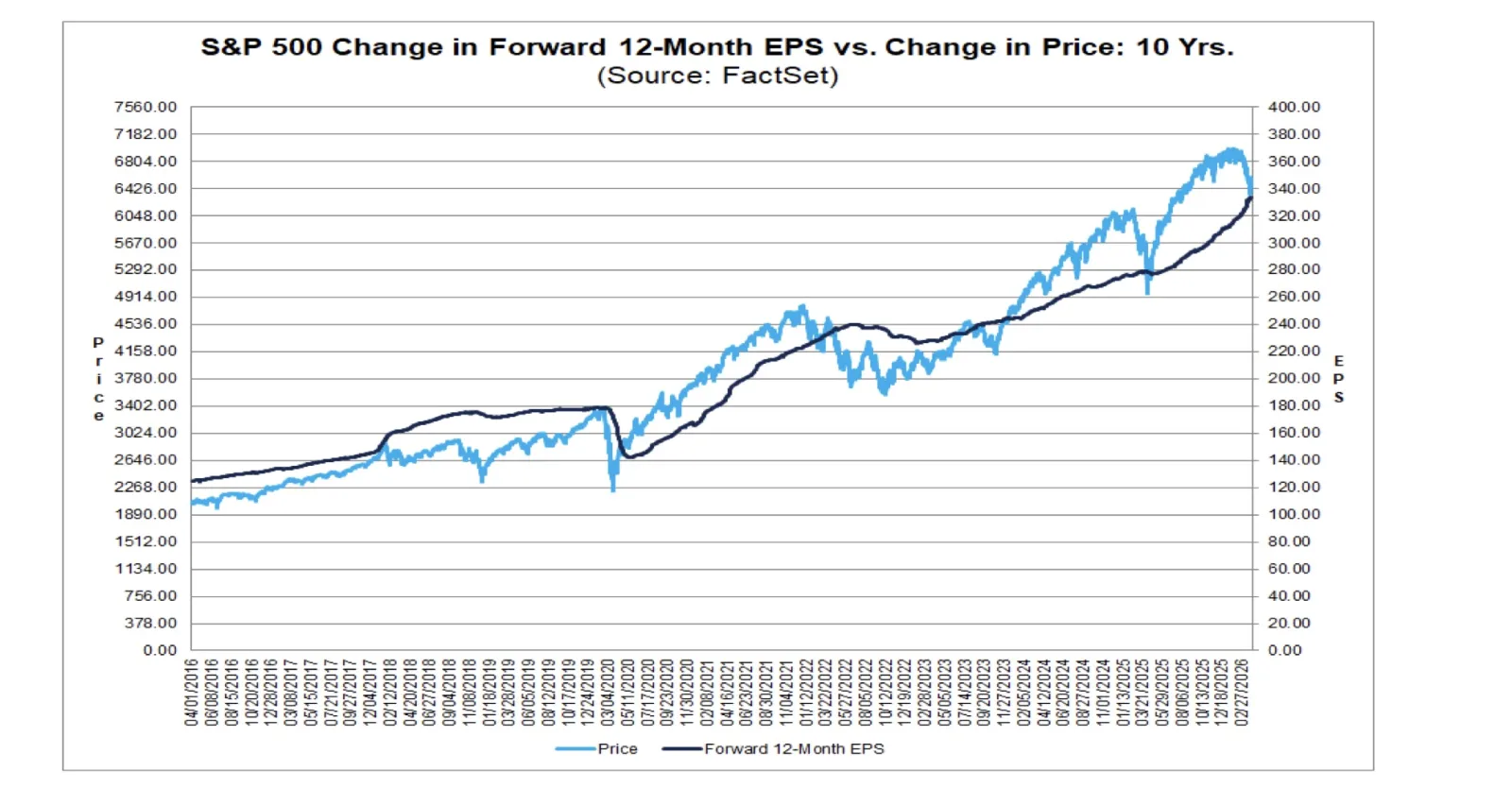
Prices fell while earnings expectations held: a repricing of uncertainty, not fundamentals. Source: FactSet Earnings Insight, March 27, 2026.
While prices fell, earnings estimates barely moved. According to FactSet's data through late March, S&P 500 companies are projected to deliver approximately 13% year-over-year earnings growth in Q1, slightly higher than where estimates began the year. Nine of eleven sectors are expected to grow earnings, and margins remain above longer-term averages.
At the same time, the market's forward price-to-earnings ratio compressed from roughly 22x at year-end to just under 20x. That is not what a collapsing fundamental picture looks like. That is repricing: investors demanding a wider margin of safety in a more uncertain environment.
What This Means
Quarters like this create a specific kind of pressure, not just in portfolios but in judgment. Statements look worse than the underlying trend. Headlines feel more urgent than the data justifies. The instinct is to wait for clarity.
That instinct is understandable, and usually wrong. By the time clarity arrives, the market has already moved. The final-day rally in March is a small example of that dynamic: the move happens before it feels comfortable.
For business owners in particular, this environment creates a different risk: conflating market volatility with what's happening in the underlying business. They're related, but they're not the same. A volatile quarter doesn't change your exit timeline or your planning work. It just makes distraction more expensive.
What We're Watching Heading Into Q2
A few things we're watching in the coming months, not as predictions but as variables.
Geopolitics and Energy
Middle East developments remain a wildcard. Oil markets are pricing some stabilization, but outcomes are still uncertain and could quickly shift inflation expectations.
The Fed Transition
Powell's term is scheduled to end in mid-May. Kevin Warsh has been nominated as a successor, though timing remains subject to confirmation. How that transition unfolds, and how policy is communicated, will matter.
Earnings Season
Q1 results begin soon. The setup is better than it feels. Estimates have held, expectations are reasonable, and if companies deliver, that could help reconnect the narrative with fundamentals.
None of this tells us what the market will do next. What it does tell us is that this is an environment that rewards precision in planning, positioning, and how risk is evaluated, rather than reaction.
Discipline tends to matter most in environments that feel most uncertain — not because the outlook is especially dark, but because the instinct to deviate is strongest when it's most expensive.
Sources
Federal Reserve Board, FOMC Statement and Summary of Economic Projections (March 18, 2026); U.S. Bureau of Labor Statistics, Consumer Price Index — February 2026; The Employment Situation — February 2026 and March 2026; U.S. Bureau of Economic Analysis, Personal Income and Outlays — January 2026 (released March 13, 2026); FactSet, Earnings Insight (March 27, 2026).
________________________________________________________________________________________________________________________________________
This commentary is for informational purposes only and does not constitute investment advice.
